
Summary
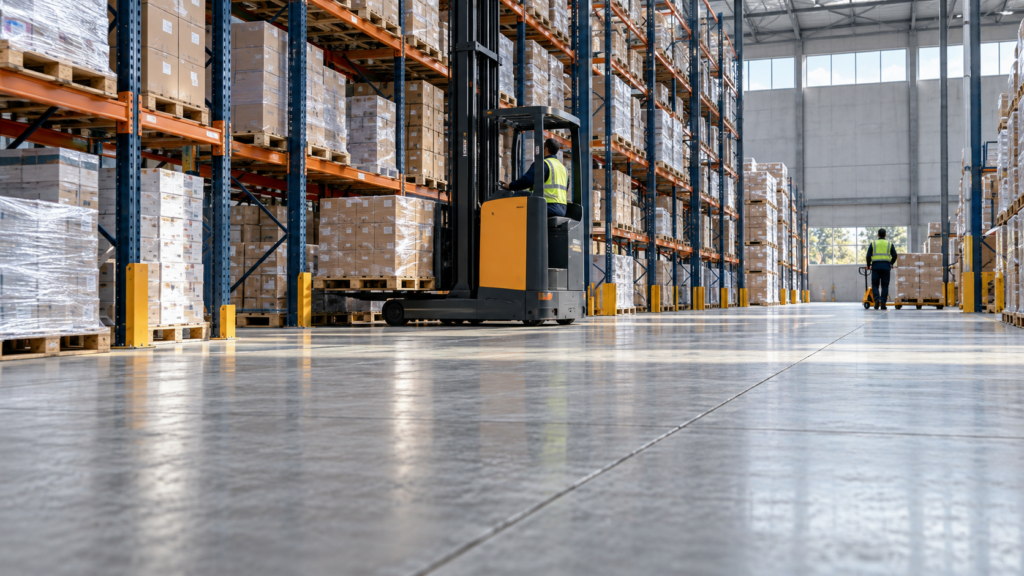
Warehouse floor performance is closely connected to the equipment moving across it — and the relationship works both ways.. Different wheels, loads and routes make different demands; a change in the operation can change what the floor needs to do. This Insight follows that relationship from a familiar pallet-jack route to automated movement, without assuming that every mark on a floor is a failure.
The route everybody knows
There is a crossing in some warehouses that nobody needs to mark on a drawing. The person pulling a pallet jack knows exactly where it is. One small load wheel reaches the joint, the handle kicks, the operator changes pace and the pallet carries on toward dispatch. By the third trip, they have learned to approach it differently.
Every warehouse has a floor. But not every warehouse asks the same things of it.
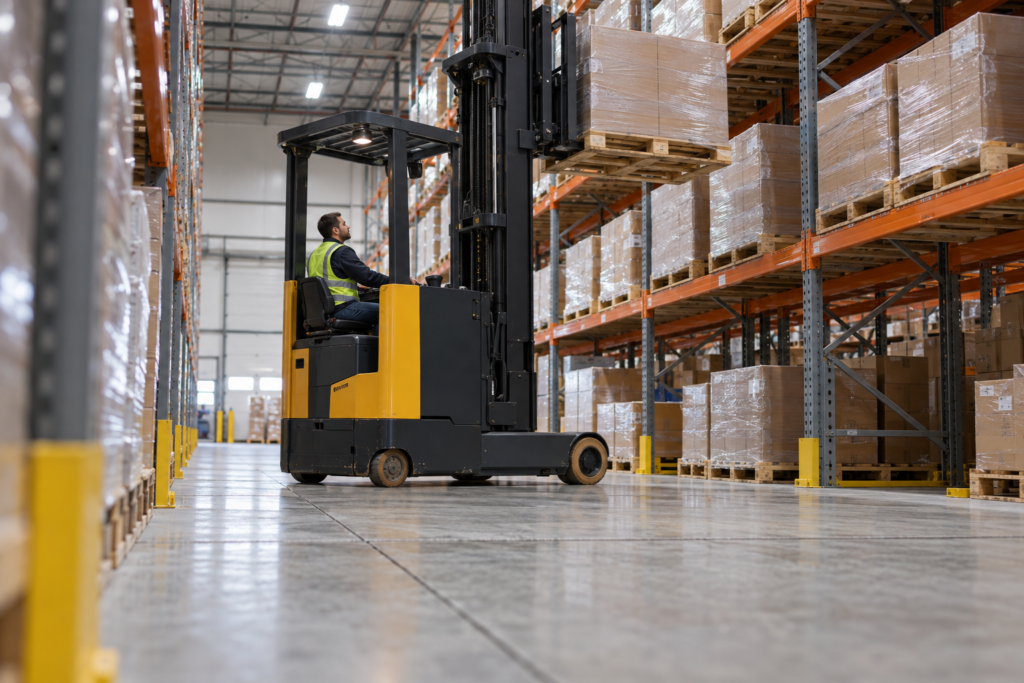
A driver in a reach truck may make the same adjustment without saying anything. The route still works, so the rough crossing becomes part of the shift. That adaptation is useful, but it can also hide a question: is the floor still suited to the movement taking place across it?
The answer depends on what is moving. A hand pallet jack, a counterbalance forklift and a high-lift reach truck do not present the same wheels, loads or responses to a joint. The ordinary word “forklift” conceals a great deal of variation.

What touches the concrete
The contact is made through the wheels. Their size, material and arrangement affect how a load passes over a local change in level. A larger, more resilient tyre may cross a rough point with less disturbance than a small, hard load wheel. That is a comparison of particular configurations, not a rule that one class of vehicle is always safe on an imperfect floor.
Toyota Material Handling, for example, recommends different pallet-truck wheel arrangements according to the surface and the work. Its bogie arrangement spreads load over multiple wheels and is better suited to uneven floors than a single fork wheel. The equipment choice and the floor condition have to be considered together.
The operator may feel a change long before a manager sees a significant defect.
Now picture a reach truck working a busy aisle. Its wheel arrangement, carried load and lifting height place different demands on the route from those of a manual pallet jack. A step at a joint or a short-wave variation in the surface may affect ride, stability or the speed at which the operator is comfortable working. The Concrete Society’s industrial-floor guidance distinguishes free movement from vehicles using defined paths, precisely because the operating pattern changes the floor-regularity question.
The journey back into the floor
The floor influences the movement. The movement also influences the floor.
A loaded vehicle transfers its weight through a few wheel contacts, then repeats that transfer along working routes. Dispatch thresholds, aisle entrances and turning points may receive many more crossings than the quiet edges of the same slab. Where a joint edge is already weak or load transfer is poor, repeated crossings can help break it down further. Braking, turning, debris and wheel choice can add to the local demand.
The location of damage often tells a more useful story than its size.
That does not establish the cause of any particular defect. Joint detailing, support, concrete quality, construction, loading and later changes of use all need consideration. A repeatedly failing repair is a reason to investigate the whole crossing, not proof that the MHE is too heavy. A small defect on the main route may matter more to an operation than a larger mark in an unused corner.
When the movement becomes programmed
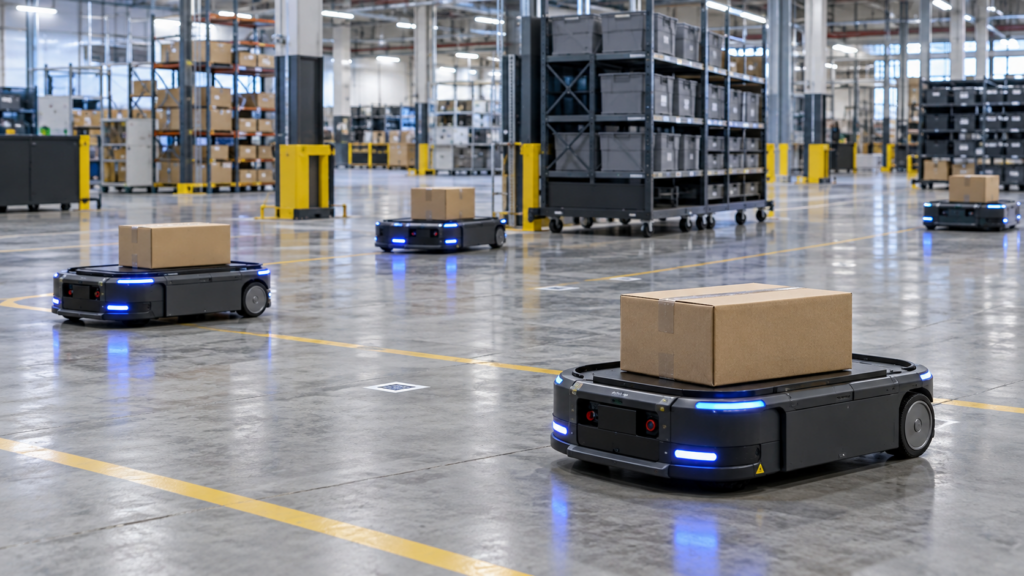
The same relationship carries into newer ways of moving goods. At Takealot’s Johannesburg facility, Geek+ has publicly reported the deployment of autonomous parcel-sorting robots supported by manual and automated induction stations. That is an example of changing movement, not evidence of a floor problem at a Takealot facility.
Automation changes the movement. It doesn’t remove the floor’s responsibility.
Automation can change where traffic concentrates, how frequently a route is used and which transitions an equipment fleet must cross. Some systems can reroute around an obstruction; others depend on particular docking points or repeated paths. Manufacturers specify different floor flatness, step, gap and slope limits for different robot models. There is no universal “robot-ready” floor grade.
A localised surface problem could affect a particular system’s movement or reliability if it falls on a critical route and exceeds that equipment’s limits. Whether it actually does is a question for the installed equipment, the layout and a measured inspection. An autonomous robot should not become a dramatic symbol for a problem that has not been demonstrated.
Look at the route as a system
A familiar jolt at a crossing may be recorded in three places. The operator reports the ride. Equipment maintenance sees wheel wear or vibration. Facilities sees a damaged joint. Operations sees a route that still works, provided people slow down. Each observation matters, but none explains the whole situation alone.
Put them together and the questions improve:
What travels along the route?
Which wheels carry the load?
How frequently does the equipment cross?
Is the joint moving, losing support or simply showing surface wear?
Has the traffic pattern changed?
Measurements and inspection can separate a floor issue from an equipment issue, a route-management issue, or a combination. Sometimes the right response is to monitor rather than repair.
That thinking belongs at the beginning of a new facility as much as in an operating one. The intended vehicles, their wheel loads, routes, lift heights and possible future changes should inform the floor requirement before it is built. Later, the actual working routes provide a test of whether the floor and operation still fit one another.
When a facility changes the way it moves goods, it is worth asking whether anyone has reassessed the surface carrying that movement. Watch the floor, the wheels and the route together; each tells part of the story.
The floor is constructed once, but its value is realised through operations for years afterwards.


