
Summary
Freezer floor problems are often treated like ordinary warehouse maintenance. In reality, cold temperatures, moisture, repeated traffic, joints and limited access interact in ways that can turn a small defect into a health-and-safety and operational risk.
This Insight explains why recurring repairs are a signal to look beneath the visible problem.
Introduction
One of the things that first made me appreciate how different freezer work is came from a repair supervisor.
He told me they need a special extension cord inside a freezer because an ordinary one can freeze and snap.
It is a small detail. But it changes the way you look at the whole environment.
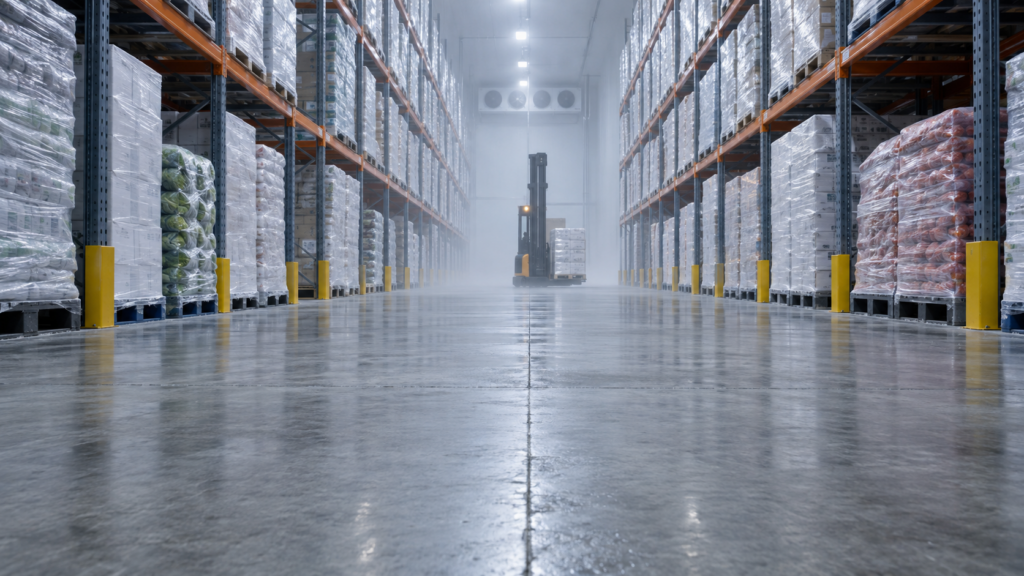
From the outside, a freezer can seem relatively simple. It is a warehouse with cold air, racking, forklifts and stored product.
Until you walk into one.
Then you realise that almost everything is working under a different set of conditions. The people. The equipment. The materials. The maintenance windows. And the floor beneath all of it.
A freezer floor is not simply an ordinary concrete floor operating at a lower temperature. It is part of a live operational system.
A freezer floor is part of a live operational system
In a cold-chain or food environment, the floor also sits inside a wider system of hygiene, safety, housekeeping and audit requirements. A damaged surface that traps moisture, produces dust or becomes difficult to clean can therefore become more than a maintenance problem.
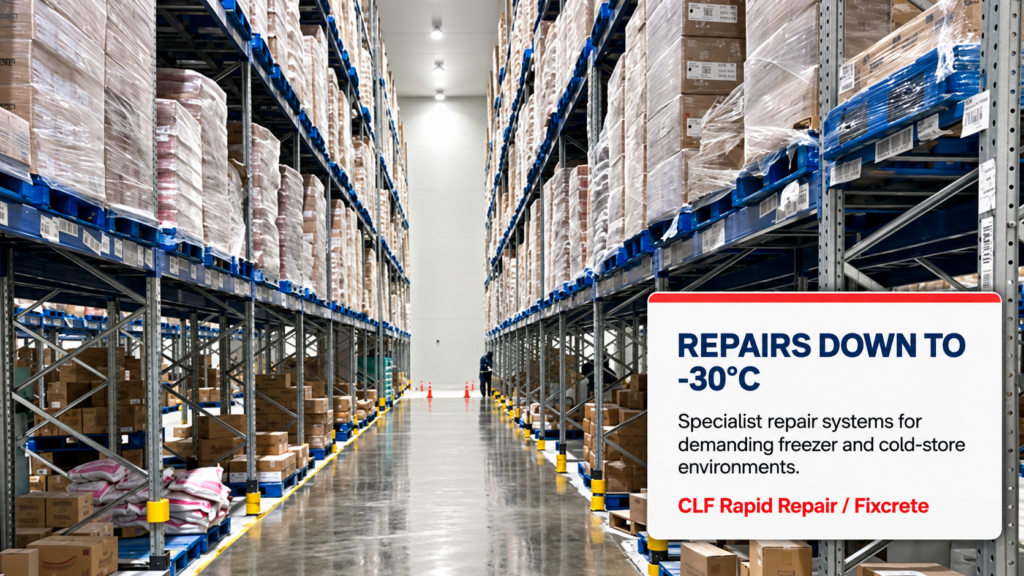
There are forklifts crossing the same routes every shift. There are joints, doorways and temperature transitions. There is moisture, ice, cleaning, hygiene, racking, uptime pressure and often very little room to take an area out of service.
A small defect can therefore become something much larger than a concrete problem. It can begin affecting safety, hygiene, equipment movement and the operation around it.
The repair that keeps returning
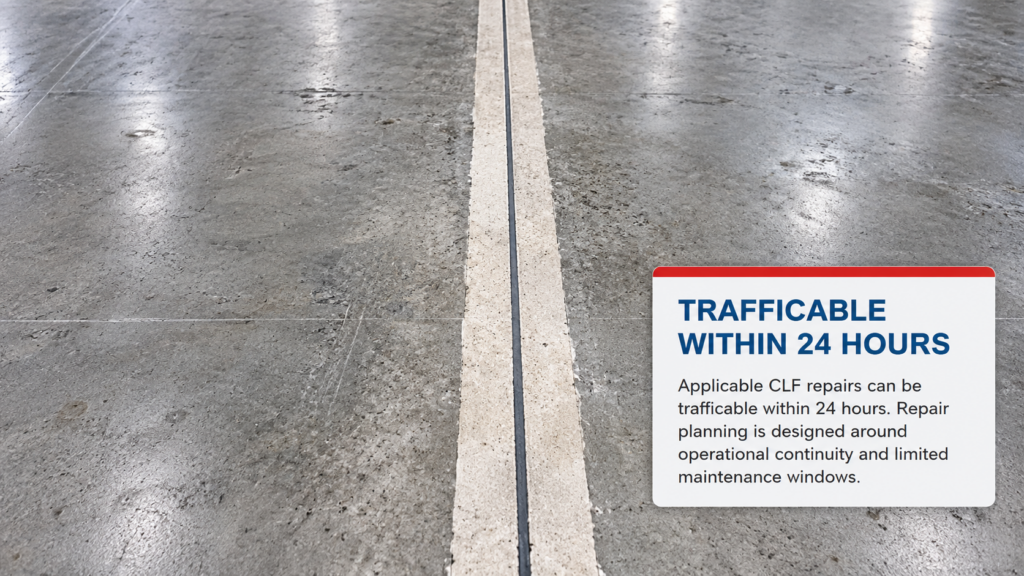
A common starting point is a damaged joint or a small pothole.
It may have been repaired before. It may not look particularly dramatic. But forklifts keep crossing it, often in exactly the same place, day after day.
The obvious question is usually:
What do we patch it with this time?
But after a while, that is not the most useful question.
Why does this particular area keep failing?
When a freezer is built, the environment is still off. Once it is brought down to operating temperature, the concrete and the surrounding system respond to the cold. Joints move through that change, and in some areas they can open significantly. Transitions become more demanding. What might have been a manageable detail in a conventional warehouse can become a repeated impact point.
Then the traffic starts.
Every wheel crossing a damaged joint adds another small impact. A rough patch becomes rougher. A chipped edge becomes a pothole. A pothole becomes something operators begin steering around.
And once people are steering around it, slowing down for it, complaining about it or repairing it repeatedly, the floor is already affecting the operation. In the wrong location, a small defect can begin creating critical operational issues for the business.
The floor affects the forklift. The forklift affects the floor.
This is one of the more interesting parts of industrial concrete floors.
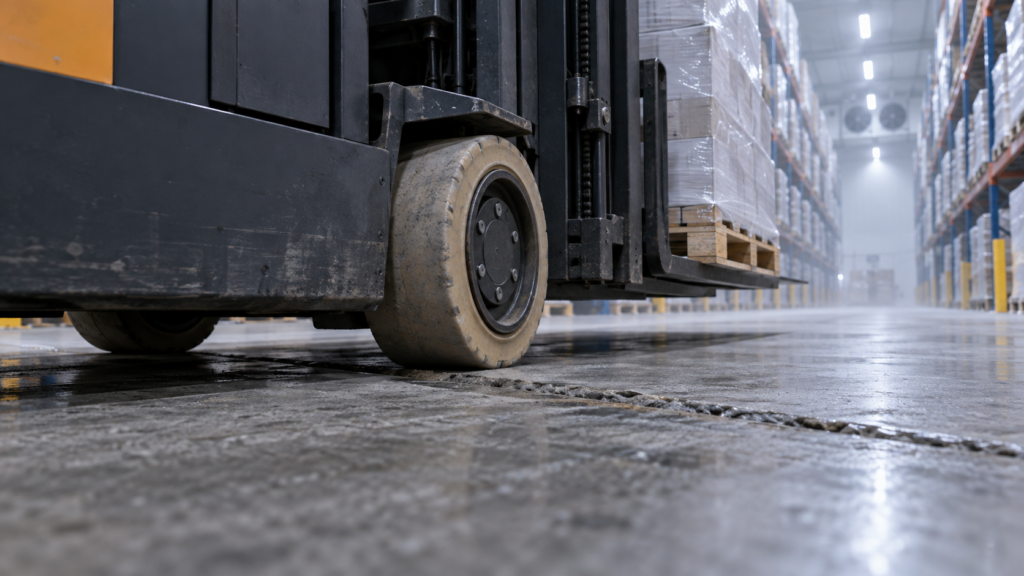
A floor defect affects the way MHE travels through a building. It can create vibration, discomfort, wheel wear, slower travel and a less predictable route through a busy operation.
But the traffic also affects the floor.
The same hard wheels crossing the same damaged point can progressively worsen the problem. The floor and the forklift are not separate issues. They are part of the same system.
In a freezer, that system is less forgiving.
The damage may be near a doorway, a threshold, a traffic aisle or a transition between temperatures. Repairs may be more difficult to plan. Access may be constrained. Hygiene requirements matter. Taking an area out of use can have consequences well beyond the repair itself.
That is why the cheapest-looking repair is not always the cheapest outcome.
Dust is not always a cleaning problem
Dusting is another example.
In some freezer facilities, the floor can produce fine dust as the surface deteriorates. The natural response is often to clean more aggressively or sweep more often.
But if the concrete surface itself is breaking down, sweeping removes the symptom. It does not necessarily remove the source.
The more useful question is not simply:
Why is this area always dusty?
It is:
What is happening to the surface of the floor?
That distinction matters in a temperature-controlled environment where cleanliness, product handling, equipment and operational discipline are already under pressure.
The visible defect is rarely the whole story
A crack, a damaged joint, a dusty surface or a recurring pothole can look like a small maintenance item.
Sometimes it is.
But sometimes it is the visible part of a larger interaction between temperature, moisture, traffic, surface condition and the practical difficulty of carrying out work inside a live freezer.
That is why repeated repair failure should be treated as a signal.
Not necessarily a signal that the entire floor has failed. Not necessarily a reason to panic.
But a reason to stop and understand what is actually happening.
When you spend enough time looking at damaged industrial floors, you start to see that the defect itself is often only the beginning of the story.
In a freezer, the story is usually bigger than it first appears.
Recurring freezer floor problems?
Recurring freezer floor problems — including repeated joint failures, dusting, potholes or surface deterioration — may be telling you something about the system around the defect. CLF can inspect the floor, identify the conditions contributing to the problem and recommend the appropriate intervention.


